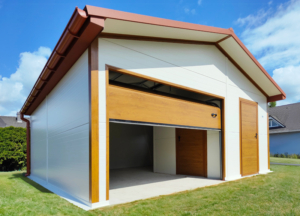
If you’re looking for an insulated mobile garage or a sandwich-panel garage, sooner or later you’ll come across three abbreviations: PIR, PUR and EPS. All three are thermal insulation materials, but the differences between them are far from trivial — making the wrong choice means you might save a bit now, but you’ll end up with a lower-quality building. In this article, we’ll explain the differences clearly, without any technical jargon.
What is the difference between PIR, PUR and EPS?
All three materials are used as thermal insulation fillers in sandwich panels, but they have different physical and safety properties.
PIR (polyisocyanurate foam)
Of the three, this material has the best thermal insulation and fire safety properties. It is self-extinguishing, does not melt when exposed to fire, and remains stable even at high temperatures. The DELUX insulated mobile garage its main ingredient.
PUR (polyurethane foam)
It used to be the industry standard, but is now increasingly being replaced by PIR. Its thermal insulation properties are inferior to those of PIR, it may melt in the event of a fire, and it can only be made self-extinguishing by adding additives.
EPS (expanded polystyrene, commonly known as „Hungarocell”)
It is the cheapest option, but also the poorest insulator of the three. It burns and melts in the event of a fire. It is acceptable for seasonal or temporary storage, but is not recommended for intensive, long-term use.
In figures: just how much better is PIR?
The measure of thermal insulation is the thermal conductivity coefficient (λ, pronounced ‘lambda’) — the lower the value, the better the insulation.
| Feature | PIR | PUR | EPS |
|---|---|---|---|
| Thermal conductivity (λ W/mK) | 0,020–0,021 | 0,022–0,024 | 0,036–0,038 |
| Self-extinguishing | ✅ Yes | ⚠️ Only when added | ❌ No |
| It melts in fire | ❌ No | ✅ Yes | ✅ Yes |
| Heat resistance | Excellent | Medium | Weak |
| Thermal insulation compared to PIR (same thickness) | — | –10% | –70% |
The figures are industry averages; manufacturers’ λ values may vary slightly.
At the same thickness, therefore, the PIR panel provides approximately 10% better thermal insulation than PUR, and is approximately 70% more efficient than EPS.
Thickness matters too — and this is often a pitfall in the market
In reality, the panels also differ in thickness, which makes this comparison even more important.
There are many people on the market who offer 20–40 mm, PUR-filled A sandwich-panel garage at an affordable price. It looks appealing at first glance, but let’s see what this actually means in terms of insulation performance:
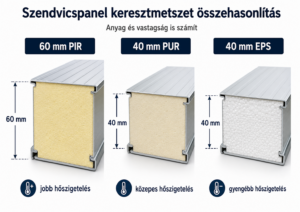
- An 60 mm PIR panel approx. Better heat retention with 64% stretches more than a 40 mm PUR panel
- The same 60 mm PIR panel more than 150% better, like a 40 mm EPS panel
This means that anyone who opts for the thinner, cheaper PUR solution will save a little in the short term, but will end up with a building of significantly poorer insulation quality, which is more expensive to heat in winter, heats up more quickly in summer and has less favourable fire safety characteristics.
Fire safety: this is something many people overlook
In buildings with a metal-clad, enclosed structure – such as a sandwich-panel garage – fire safety characteristics are particularly important.
- A PIR self-extinguishing: it does not melt and retains its structure even when subjected to high temperatures
- A PUR it can only be made self-extinguishing with additives; on its own, it burns and melts
- From EPS burns and melts quickly in the event of a fire
This difference is relevant throughout the garage’s entire lifespan, particularly if you store cars, tools or flammable materials in the building.
Which one do we recommend, and why?
The DELUX insulated mobile garage is essentially constructed from sandwich panels with a PIR core, with wall thicknesses of 60 or 100 mm. EPS panels are also available in certain colour options, in thicknesses of 50 or 100 mm, exclusively for those who deliberately choose the more cost-effective solution and where the application justifies it (e.g. seasonal storage, where maximum thermal insulation is not a priority). However, from the point of view of thermal insulation and fire safety, PIR is always the better choice, which is why we recommend it to all customers.
We do not recommend garages made from sandwich panels with a PUR foam core, particularly those with a thickness of 20–40 mm, neither in our own range nor elsewhere. Not because all PUR solutions are bad, but because the combination of thin wall thickness and a weaker insulating material is a compromise from which the customer does not gain enough to make it worthwhile.
Summary
If you’re buying an insulated mobile garage for the long term, with a view to reliable quality and genuine thermal insulation:
- Choose PIR-equipped sandwich panel
- Minimum 60 mm wall thickness
- Avoid the 20–40 mm PUR quotes, as the price difference is not commensurate with the quality received
If you haven’t yet read our comprehensive guide to sandwich-panel garages, including prices, dimensions and planning permission, you can find it here: Sandwich-panel garage: everything you need to know before buying